Prioritisation & focus
Distinguishing the important from the urgent, using time and attention more deliberately, and maintaining direction as pressure increases.
Leadership Effectiveness
Leadership Effectiveness is for situations where the core remit remains, but the demands on how the role needs to be performed have changed or become clearer. The focus is on strengthening the ability to prioritise, make decisions, communicate, distribute responsibility and create momentum around the role.
The programme starts with the actual role and the situations in which something needs to work better – not with a generic ideal of good leadership.
When is the programme relevant?
In an established role, the development need often becomes visible when demands increase, complexity grows or established ways of working no longer produce the same effect. It can show up in several ways.
Operational issues, interruptions and short-term decisions consume a disproportionate amount of time and attention.
Issues are escalated unnecessarily, responsibility becomes person-dependent or decisions are made too late.
Priorities, expectations and messages are interpreted differently or have too little impact.
Delegation, follow-up or trust do not work well enough to create genuine ownership.
Research evidence
70%
of the variance in team engagement can be linked to the manager or team leader.
Gallup’s global workplace research shows that the manager or team leader accounts for around 70% of the variance in engagement between teams. This does not mean the manager alone creates engagement; rather, differences in how teams are led are a very strong explanation for why engagement varies between teams.
For Leadership Effectiveness, the point is simple: clarity, feedback, accountability, development and the quality of day-to-day leadership are material factors – not soft side issues.
Programme focus
Leadership Effectiveness is not generic leadership training. Development is concentrated on the areas that matter most for the role to work better in its real context.
Distinguishing the important from the urgent, using time and attention more deliberately, and maintaining direction as pressure increases.
Making decisions at the right level, at the right time and with sufficient quality – without creating unnecessary dependency or indecision.
Creating clarity, understanding and direction in relationships, meetings and situations where leadership needs to have real impact.
Distributing responsibility and authority so that others can act with appropriate autonomy while follow-up and quality are maintained.
A common pattern
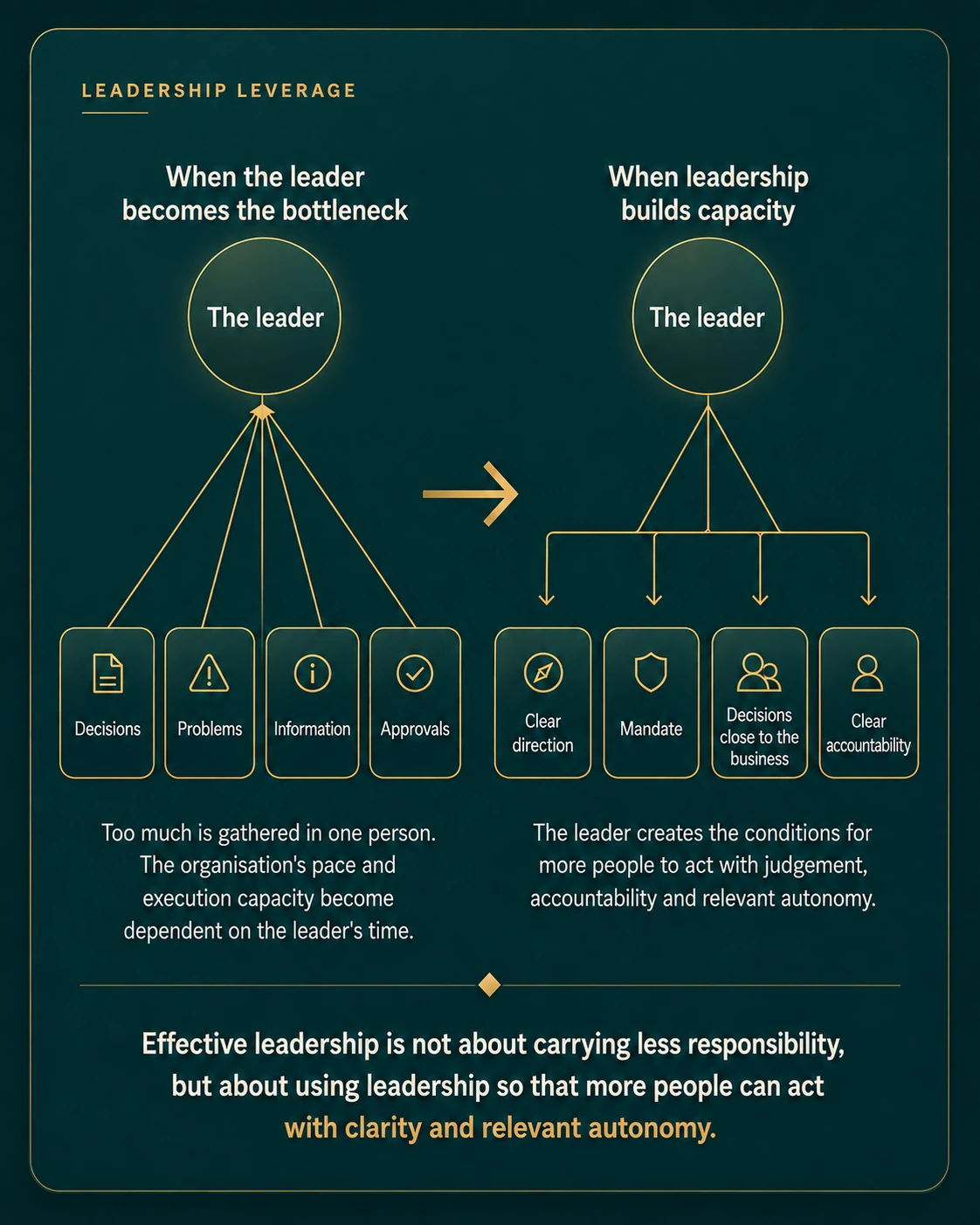
A common – but not the only – challenge in established leadership roles is that too much knowledge, problem-solving, decision-making and approval accumulates with the same person. This can create speed in the short term while making the organisation dependent on the leader’s time and availability.
The relevant shift is not to take less responsibility, but to use leadership in a way that builds clarity, judgement and capacity for action in more places.
What should become visible?
The exact target state depends on the assignment and context, but the value needs to be visible day to day – not only in reflection.
More deliberate focus, better judgement and fewer reactive patterns when day-to-day reality becomes complex.
Clearer authority, stronger ownership and fewer unnecessary escalations or reversals.
Greater clarity, pace and capacity where leadership has direct influence – without promising outcomes that depend on multiple factors.
A first conversation starts with the situation, the remit and what needs to work differently in the real day-to-day role.